
Descripción
Located in the heart of the historic center of Icod de los Vinos, Plaza Luis León Huerta stands on the former site of the Convent of San Sebastián, founded by the Augustinian order in the 16th century. Originally, a small hermitage dedicated to Saint Sebastian—the traditional patron invoked against contagious diseases—stood here, strategically built in an elevated and well-ventilated area that, at the time, lay on the outskirts of the town.
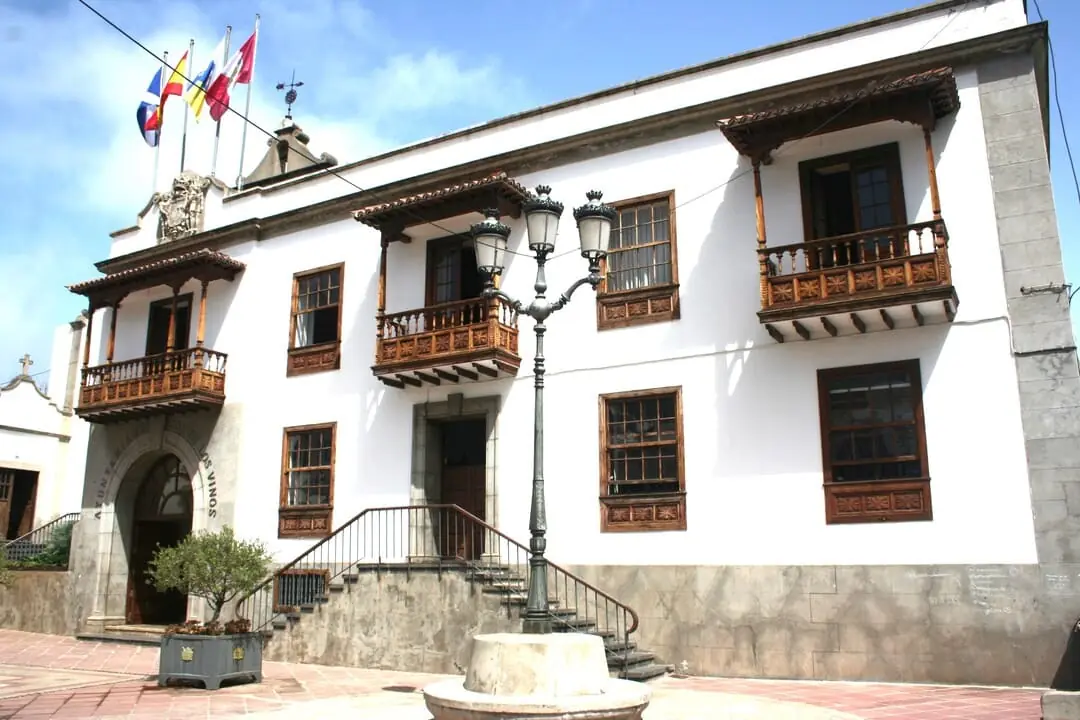
Today, the square is home to three notable buildings: the Town Hall, built in the 1950s in Neo-Canarian style; the Church of San Agustín; and a private eclectic residence with striking modernist details on its façade.
Town Hall
The current Town Hall of Icod de los Vinos occupies part of the former site of the Augustinian Convent of San Agustín, which was demolished in 1953. It adjoins the church of the same name—once the convent’s main chapel—and was constructed between 1952 and 1957 under the direction of architect Tomás Machado y Méndez Fernández de Lugo, one of the leading figures of the Neo-Canarian architectural movement.
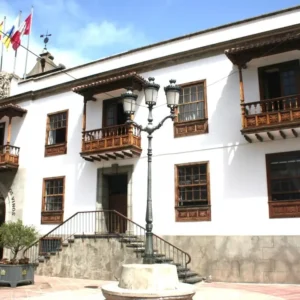
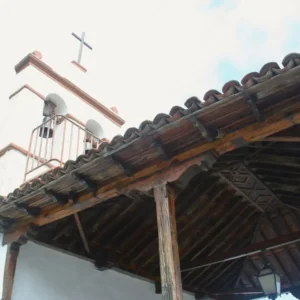
The two-story, L-shaped building is distinguished by its large wooden balcony, semicircular stone arch, and the carved municipal coat of arms above the main entrance. Traditional Canarian architectural elements such as masonry, stone plinths, and ornamental woodwork are seamlessly integrated into its design.
Originally, the building was conceived not only to house municipal offices, but also to include a school, market, library, and commercial spaces on the ground floor. Its construction also transformed the surrounding area, reorganizing the urban layout around Plaza Luis León Huerta.
Church of San Agustín
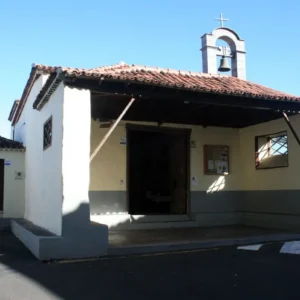
The Augustinian Convent of San Sebastián, the oldest of its kind in Icod de los Vinos, originated from a donation made in 1585 by Bishop Fernando Rueda of the Canary Islands, who granted the small Hermitage of San Sebastián to the Augustinian Order to establish their monastery. Although the convent itself has disappeared, the Church of San Agustín remains—the only surviving structure after the site was redeveloped for the construction of the Town Hall and Plaza Luis León Huerta. The entire complex lies within the Historic Quarter of Icod de los Vinos, declared a Site of Cultural Interest (Bien de Interés Cultural).
From its founding, the convent enjoyed the patronage of prominent local families—Alzola, Fernández, Montiel, and Esteves—who financed chapels, altars, and other works within the church. This support fueled the convent’s growth and prosperity during the 17th and 18th centuries. Following the Ecclesiastical Confiscation of 1821, the convent was closed, and its church ceased religious services. By 1822, the building was repurposed for civil uses, including a charitable institution and a school. The church was later reopened in 1861 as an auxiliary parish of San Marcos, with Saint Augustine as patron and Our Lady of Grace and Saint Sebastian as co-patrons.
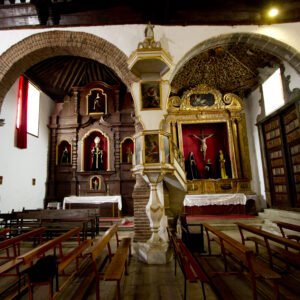
The Church of San Agustín is a fine example of Canarian Mudéjar architecture, notable for preserving two brick arches—unique in the Canary Islands. One of them, dated 1599 and completed before 1608, separates the main chapel from the nave. Both rest on elegant Tuscan-style columns. Although heavily altered in the 20th century, the façade still bears a stone inscription from 1777 above the main entrance.
The Square
Originally known as Plaza de San Agustín until the mid-20th century, the square was once characterized by a central garden that featured the Neptune Fountain, later relocated to the Franciscan convent. Its complete redesign took place between 1953 and 1957, again under the direction of Tomás Machado y Méndez Fernández de Lugo. The renovation aimed to create a functional civic ensemble, incorporating the new Town Hall, market, schools, and commercial spaces.
The square’s current name honors Luis de León-Huerta y González-Grillo (1797–1862), an influential 19th-century political and social figure, 8th Marquis of Villafuerte, and President of the Provincial Council of the Canary Islands.
One of the most remarkable features of the square is the Sculptural Ensemble of the Four Seasons, composed of four white Carrara marble statues dating to around 1883. These allegorical figures represent Spring, Summer, Autumn, and Winter, showcasing the neoclassical style popular in Europe during the 18th and 19th centuries. Though their exact origin remains unknown, the statues already adorned the square prior to its 1950s renovation.
Plaza Luis de León Huerta, S/N, 38430 Icod de los Vinos, Santa Cruz de Tenerife
Valoraciones
No hay valoraciones aún.